
Simple referee flags
search
  • Simple referee flags
  • Simple referee flags
  • Simple referee flags
  • Simple referee flags
  • Simple referee flags

Simple referee flags

€11.76

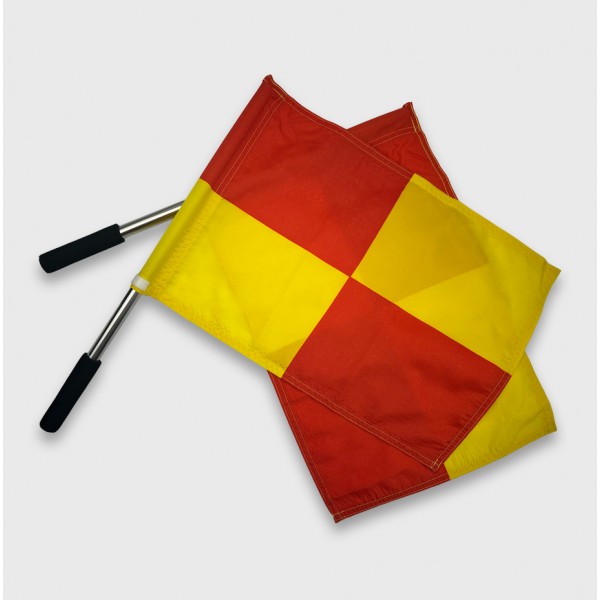
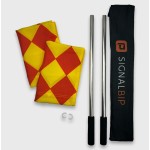
This set of single touch flags includes:

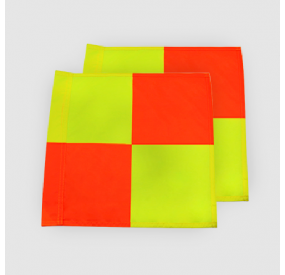
2 pennants (checkerboard or diamond pattern)

2 non-slip sleeves

1 carrying case

2 plastic clips

These flags are not electronic or rotating!
Choose your options

Fanion:
Quantity
Product available with different options

Discover more about : Simple referee flags

These SignalBip touch flags for assistant referees have been designed to offer a more classic alternative to our electronic flags.

  • The aluminum handle is durable and the non-slip grip makes it easy to hold.
  • The orange and yellow checkerboard design enhances the visibility of the gesture.

These flags are not electronic!

Assistant referee flags play a crucial role in the smooth running of a soccer or rugby match. Here are their main functions, with details of their use in each sport:

What are referees' touch flags used for in soccer?

  1. Indication of offside: Assistant referees indicate offside positions. If a player is in an offside position when the ball is passed to him, the assistant referee indicates this by raising his flag to alert the main referee.
  2. Ball out: The assistant referee uses his flag to indicate that the ball has completely crossed the touchline or the goal line, signaling a touch or a corner.
  3. Fouls and infringements outside the main referee's view: Assistants can also signal fouls that occur outside the main referee's field of vision, such as foul play or unsportsmanlike behavior.
  4. Substitutions: Assistant referees signal player changes by raising their flag to indicate that a replacement is imminent.
  5. Additional time: The assistant referee can also signal additional time to be added at the end of each half.

What are rugby referees' touch flags used for?

  1. Touch offs: The touch judge uses his flag to signal when the ball is out of play in touch, enabling the throw-in to be determined quickly.
  2. Fouls and infringements: As in soccer, the linesman signals fouls that the main referee may not have seen, such as offside positions or dangerous tackles.
  3. Scrum and throw-in: Touch judges are also responsible for ensuring that the ball is thrown in correctly during touch-ins, and that scrummaging is carried out correctly.
  4. Assistance with tries: If there is any doubt about the validity of a try, the linesman helps the main referee to make a decision by checking that the ball has been placed in the in-goal.

In short, assistant referee flags are used to signal various important situations and assist the main referee in making a decision. Whether in soccer or rugby, these flags are essential to ensure the smooth flow of play and the correct application of the rules.

SBF
0 Items

Data sheet

Flag with pole
675 x 42 x 49 mm

You might also like

Comments (0)
No customer reviews for the moment.